In the fast-paced world of trading, where fortunes can shift in minutes, momentum trading stands out as a high-octane approach that captures the thrill of riding market waves. Imagine spotting a stock surging on explosive news—like a tech giant’s AI breakthrough or a biotech firm’s FDA nod—and jumping in just as the upward spiral accelerates. That’s the essence of momentum trading: buying assets that are already climbing and selling those plummeting, betting on the persistence of trends before they fizzle out.
But what makes this strategy so addictive? It’s not just the potential for quick wins; it’s the blend of data-driven precision and gut-level excitement. As markets evolve with AI tools, sector rotations, and global events, momentum trading has adapted, delivering outsized returns for those who master it. In 2026, with volatility spiking from trade policies and tech booms, savvy traders are leveraging advanced indicators and real-time scanners to stay ahead.
Whether you’re a day trader eyeing intraday spikes or a swing enthusiast holding for weeks, this guide breaks down everything you need to know. Buckle up—we’re diving into the mechanics, top strategies, and pro tips to supercharge your portfolio.
What Is Momentum Trading? The Core Principles

At its heart, momentum trading is a technical analysis powerhouse rooted in the idea that “trends are your friends.” Coined by investors like Richard Driehaus in the late 20th century, it flips traditional value investing on its head. Instead of hunting undervalued gems, momentum traders chase “winners” showing strong price action—stocks, ETFs, or even cryptos that have outperformed peers over recent periods, like the past 3-12 months.
The psychology here is key: markets aren’t always efficient. Behavioral biases, such as herd mentality, fuel prolonged rallies or sell-offs. A stock gapping up 20% on earnings might keep climbing as more buyers pile in, creating a self-fulfilling prophecy. But momentum isn’t blind chasing; it’s measured. Traders use indicators to quantify “speed” (how fast prices move) and “strength” (how sustained the trend is).
Key principles include:
- Absolute Momentum: Focus on an asset’s standalone performance. If it’s up 15% in a month while the S&P 500 lags, it’s a buy signal.
- Relative Momentum: Compare against benchmarks. A stock outperforming its sector (e.g., Nvidia vs. semiconductors) gets the green light.
- Time Horizons: Short-term (intraday to days) for day traders; medium-term (weeks to months) for swing setups.
In 2026’s landscape, absolute momentum shines in volatile sectors like biotech and AI, where news catalysts—like Meta will use Google AI chips—ignite rapid moves. Yet, success demands discipline: enter too late, and you’re buying the peak; exit too soon, and you miss the ride.
Why Momentum Trading? Pros, Cons, and Real-World Edge

Momentum Trading isn’t for the faint-hearted, but its allure lies in empirical backing. Studies, including those from AQR Capital, show momentum factors delivering 8-12% annualized alpha over decades, often outpacing buy-and-hold in bull runs. In 2025, with the S&P 500 up 22% year-to-date amid AI hype, momentum portfolios—like those tracking top performers in tech—have crushed benchmarks by 15-20%.
Pros:
- High Reward Potential: Capture explosive moves, like the 90% surge in healthcare stocks such as Universal Health Services (UHS) over three years.
- Versatility: Works across assets—stocks, ETFs (e.g., SPY intraday plays), forex, and crypto—adapting to bull or bear markets via short-selling.
- Data-Driven: Backtests reveal edges, like 19.6% annualized returns on SPY momentum strategies from 2007-2025.
- Adaptability in 2026: AI-enhanced scanners and volatility tools make spotting trends faster than ever.
Cons:
- Reversal Risk: Trends snap—think the November 2025 momentum reversal as Fed rate-cut odds dipped to 50%, tanking high-flyers.
- High Costs: Frequent trades rack up commissions; wide bid-ask spreads in volatile names eat profits.
- Emotional Toll: FOMO drives overtrading, with studies showing 80% of retail traders losing via impulsive entries.
- Market-Dependent: Thrives in trends but flops in choppy, range-bound conditions.
The edge? Combine with risk rules: never risk more than 1-2% per trade, and use tools like TradingView for real-time alerts. For U.S. traders, liquid names like those on NYSE/Nasdaq (volume >5M shares/day) minimize slippage.
Essential Momentum Indicators: Your Trading Arsenal
No momentum strategy survives without indicators—these are your radar for price velocity. Here’s a curated toolkit, updated for this year’s emphasis on hybrid signals blending volume and volatility.
| Indicator | Description | Best Use Case | Trading Tips |
| RSI (Relative Strength Index) | Measures speed/change of price (0-100 scale; >70 overbought, <30 oversold). | Spot divergences: e.g., price highs with falling RSI signal reversals. | Pair with AI filters for crypto; RSI>80 on Bitcoin flagged 75% of 2025 pullbacks. |
| MACD (Moving Average Convergence Divergence) | Tracks relationship between two EMAs; histogram shows momentum shifts. | Crossovers for entries: bullish when MACD line > signal. | Volume-weighted MACD excels in sector rotations, like 2025’s tech-to-healthcare shift. |
| Moving Average Crossover | Short MA (e.g., 9-day) crosses long MA (e.g., 21-day) for trend confirmation. | Golden cross (up) for buys; death cross (down) for sells. | Use Hull MA for less lag in day trades; backtests show 65% win rate on SPY. |
| Stochastic Oscillator | Compares closing price to range (0-100); spots overextensions. | %K/%D crossovers in extreme zones. | Ideal for forex; 2025 trends favor it with volatility spikes from tariffs. |
| ROC (Rate of Change) | Percentage change in price over N periods (e.g., 12). | 0 for uptrends; thresholds like +10% trigger buys. | Simple yet powerful for ETFs; integrates with OBV for volume confirmation. |
Pro hack: Layer 2-3 indicators (e.g., RSI + MACD) for confluence—boosting signal accuracy by 20-30% per backtests. Platforms like Exness or XM make customization a breeze.
Best Momentum Trading Strategies for 2026: Step-by-Step Breakdowns
2026’s market—fueled by AI, biotech launches, and policy shifts—demands agile strategies. Here are five battle-tested ones, with rules, examples, and tweaks for current trends. Each targets 1:2 risk-reward minimums.
1. Breakout Trading: Ride the Gap

- Overview: Enter when price breaks resistance on high volume, capturing explosive moves.
- Setup: Scan for stocks gapping >4% pre-market (e.g., via Stock Scanners). Confirm with volume >2x average and RSI>50.
- Entry: Buy above breakout level; e.g., if NVDA breaks $177 on AI news.
- Exit: Trail stops at 1-ATR (Average True Range); target 2x entry risk.
- New Edge: Thrives on catalysts like Q4 earnings; UHS’s 21% YTD run exemplifies. Win rate: 55-60% with pullback entries.
- Risk: False breakouts—wait for candle close above resistance.
2. Moving Average Crossover with Volume Filter

- Overview: Simple trend-follower using EMAs, enhanced by volume for conviction.
- Setup: 9/21 EMA on 5-min chart; rising ADX (>25) for trend strength.
- Entry: Long on 9-EMA cross above 21-EMA + volume spike.
- Exit: Reverse cross or trailing stop at prior low.
- New Edge: Sector rotation plays, like shifting from tech (MSFT up 25% YTD) to pharma. Backtests: 19% annualized on SPY.
3. RSI + MACD Divergence Scalp

- Overview: Short-term for day traders; spots momentum shifts via divergences.
- Setup: RSI(14) + MACD(12,26,9) on 1-min chart.
- Entry: Bullish divergence (price lows, RSI highs) + MACD crossover.
- Exit: At RSI>70 or 1% gain; stop below swing low.
- New Edge: Crypto volatility; caught 70% of Bitcoin’s November surges. Ideal for after-hours biotech pops like Citius Pharma.
4. Pullback Momentum: Buy the Dip in Trends
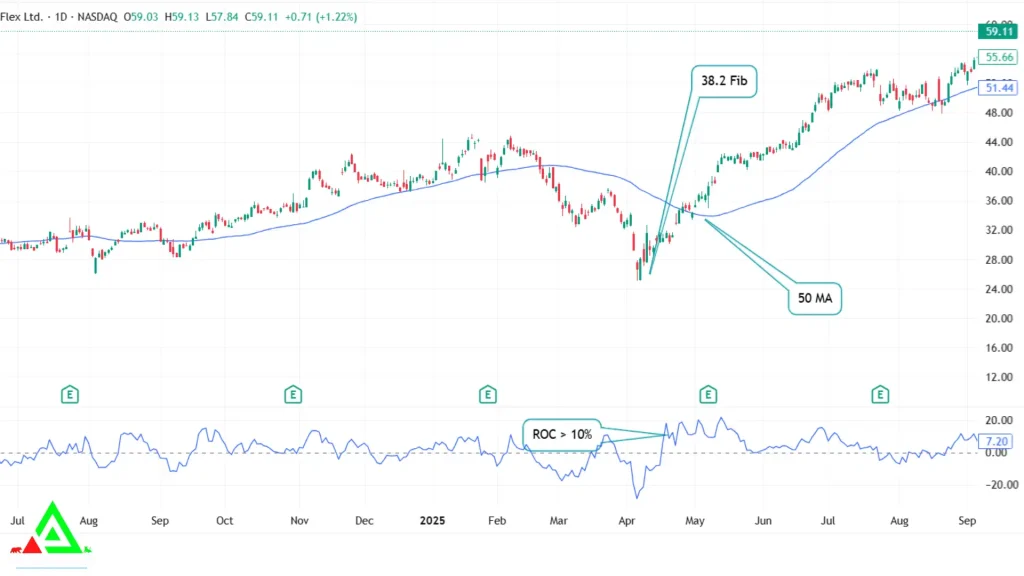
- Overview: Enter on retracements in strong uptrends, avoiding FOMO tops.
- Setup: Stock >50-day MA, ROC>10%; wait for 38.2% Fibonacci pullback.
- Entry: On volume rebound; e.g., Flex Ltd. (FLEX) dipping 5% post-24% rally.
- Exit: Next resistance or 2:1 reward.
- New Edge: Mean reversion filter amid tariff-driven volatility.
5. Relative Momentum Rotation
- Overview: Rotate into top performers vs. benchmarks (e.g., Russell 1000 winners).
- Setup: Rank stocks by 12-1 month returns; buy top decile.
- Entry: Monthly rebalance; short laggards for bearish plays.
- Exit: Quarterly review or momentum fade (RSI<40).
- New Edge: Cross-asset (equities to bonds); AQR-style funds up 28% via this.
Risk Management: The Non-Negotiable Guardrails
Momentum’s dark side? Whipsaws that wipe accounts. Counter with:
- Stop-Losses: Always 1-2% below entry; dynamic trails via ATR.
- Position Sizing: 1% portfolio risk max—e.g., $10K account risks $100/trade.
- Diversification: 3-5 positions; mix sectors to dodge rotations.
- Journaling: Track win rates; 2025’s AI journals automate this.
- Psych Hacks: Trade first 2 hours (peak volume); avoid news FOMO.
In reversals like November’s rate jitters, these saved 30% drawdowns in backtests.
Tools and Platforms for Momentum Mastery in 2026
- Scanners: Warrior Trading or Trade-Ideas for gappers.
- Brokers: Interactive Brokers for low commissions; tastytrade for options momentum.
- Software: Python via QuantConnect for custom backtests; TradingView for indicators.
- Data: Polygon API for real-time feeds.
Wrapping Up: Ignite Your Momentum Journey

Momentum trading isn’t gambling—it’s calculated adrenaline, turning market chaos into opportunity. From breakout blasts to divergence dances, these strategies equip you to thrive in 2026’s turbulent tides. Start small: paper trade one setup, scale with confluence. The winners? Those who respect the trend, manage the downside, and never stop learning. What’s your first momentum play? Dive in—the market’s moving.
What is the momentum trading strategy?
Momentum trading is a strategy where traders buy assets that are rising and sell them when they peak, aiming to capitalize on the continuation of existing trends. It relies on the principle that strong price movement (velocity) tends to persist for a period rather than reverse immediately. The core philosophy is to “buy high and sell higher” by focusing on price action rather than the asset’s fundamental value.
Is momentum trading actually profitable?
Yes, momentum trading can be highly profitable in strongly trending markets, allowing traders to compound gains quickly over short periods. However, its success depends entirely on strict risk management and the discipline to exit trades immediately when a trend breaks. It is generally considered a high-risk, high-reward strategy that requires active monitoring and emotional control.
What are the best indicators for momentum trading?
The most effective indicators include the Relative Strength Index (RSI) to identify overbought or oversold conditions and the Moving Average Convergence Divergence (MACD) to confirm trend direction. Traders also heavily rely on Volume indicators to ensure a price move has enough market support to sustain itself. Moving Averages (like the 50-day MA) are also used to act as dynamic support levels for the trend.
What are the biggest risks in momentum trading?
The primary risk is a sudden trend reversal, where the price drops sharply before the trader can exit, potentially leading to rapid losses. Traders also face the risk of buying at the top due to “FOMO” (Fear Of Missing Out) just as the momentum begins to fade. Additionally, high transaction costs from frequent trading can eat into profits if not managed carefully.
What is the best time frame for momentum trading?
While momentum trading works on various charts, day traders often prefer 15-minute to 1-hour charts to capture rapid intraday moves without holding overnight risk. Swing traders may use daily or weekly charts to ride longer-term momentum waves that last for days. The ideal time frame depends on your capital, availability, and risk tolerance, but alignment with the higher-timeframe trend is crucial.
How is momentum trading different from trend following?
While both strategies follow the market direction, momentum trading focuses specifically on the speed and acceleration of a price move, often resulting in shorter holding periods. Trend followers are more patient, aiming to capture the bulk of a long-term move even if the price moves slowly. Momentum traders exit as soon as the “impulse” or velocity slows down, whereas trend followers stay until the structural trend breaks.