In today’s fast-paced financial world, where split-second decisions can make or break fortunes, data science has emerged as a game-changer for traders and investors. Imagine harnessing vast amounts of information—from historical price patterns to real-time social media buzz—to uncover hidden opportunities and mitigate risks.
This isn’t science fiction; it’s the reality of modern stock trading. Whether you’re a seasoned investor or just dipping your toes into the market, understanding how data science powers intelligent trading can give you a significant edge. Let’s dive into the strategies, tools, and emerging trends that are reshaping how we approach the stock market.
Understanding Data Science in Stock Market Trading
Data science combines statistics, programming, and domain expertise to extract meaningful insights from complex datasets. In stock trading, it involves analyzing financial data like prices, volumes, and economic indicators to inform decisions. Unlike traditional methods that rely on intuition or basic charts, data science uses advanced algorithms to process massive volumes of information quickly and accurately.
At its core, data science helps traders move beyond guesswork. For instance, it can identify patterns in market behavior that humans might miss, such as subtle correlations between global events and stock movements. This shift toward data-driven investing has led to more efficient portfolios and higher returns, as models learn from past data to predict future outcomes.
Key Applications of Data Science in Trading

Data science isn’t just about crunching numbers—it’s about turning those numbers into actionable strategies. Here are some of the most impactful ways it’s applied in the stock market:
Predictive Analytics for Forecasting Market Trends
Predictive analytics uses historical data to forecast future stock prices and market trends. Techniques like time-series analysis, including ARIMA models, help traders anticipate movements in assets such as stocks or indices. By examining patterns from past performance, these models can signal potential buys or sells, making investment decisions more precise and timely.
For example, machine learning algorithms like Long Short-Term Memory (LSTM) networks analyze sequential data to predict price fluctuations. This is particularly useful in volatile markets, where early detection of trends can lead to substantial gains. Investors can also incorporate external factors, such as economic reports or geopolitical events, to refine these predictions.
Sentiment Analysis: Gauging Market Mood
The stock market isn’t just driven by numbers—emotions play a huge role. Sentiment analysis scans news articles, social media posts, and online forums to measure public opinion about companies or sectors. Using Natural Language Processing (NLP), data scientists can quantify whether sentiment is positive, negative, or neutral, helping traders predict how it might influence prices.
When market sentiment shifts rapidly, it often triggers significant price changes. Tools that track this in real-time allow investors to spot profitable opportunities, like entering a trade when optimism surges or exiting before pessimism takes hold.
Algorithmic Trading: Automating Decisions
Algorithmic trading, or algo-trading, automates buy and sell orders based on predefined rules derived from data analysis. These algorithms monitor market conditions and execute trades at optimal times, often in milliseconds. Popular strategies include momentum trading, where bots buy rising stocks and sell falling ones, or mean-reversion approaches that capitalize on price corrections.
Data science enhances algo-trading by integrating machine learning to adapt strategies dynamically. For instance, models can use reinforcement learning to improve over time, learning from successful and failed trades. This automation reduces human error and enables high-frequency trading, where thousands of transactions occur daily.
Risk Management and Portfolio Optimization
No trading strategy is complete without robust risk management. Data science builds models that assess potential risks by analyzing historical volatility, correlations between assets, and external threats like market crashes. Predictive algorithms can simulate scenarios to recommend portfolio adjustments, ensuring diversification and minimizing losses.
Additionally, optimization techniques use data to balance risk and reward. By evaluating factors like expected returns and constraints, these models help create portfolios that align with an investor’s goals, whether it’s steady growth or aggressive gains.
| Application | Key Benefits | Tools/Techniques |
| Predictive Analytics | Accurate forecasting, timely decisions | ARIMA, LSTM, Regression Models |
| Sentiment Analysis | Insight into market emotions, trend spotting | NLP, Text Mining |
| Algorithmic Trading | Speed, efficiency, reduced errors | Reinforcement Learning, Bots |
| Risk Management | Lower losses, optimized portfolios | Simulation Models, Variance Analysis |
Essential Tools and Technologies for Data-Driven Trading
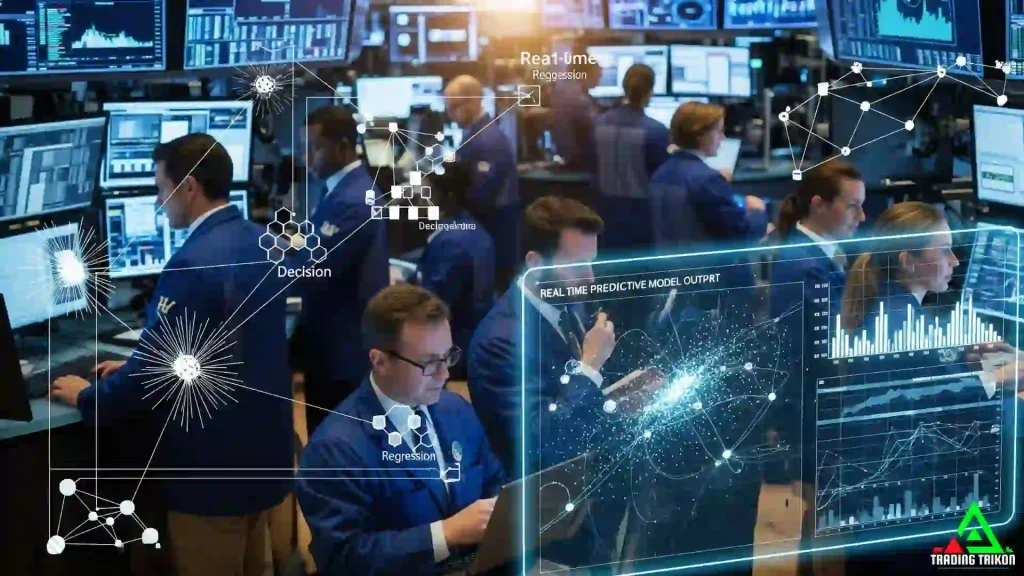
To leverage data science effectively, traders need the right tools. Python and R are go-to programming languages for building models, with libraries like Pandas for data manipulation, Scikit-learn for machine learning, and TensorFlow for deep learning.
High-quality datasets are crucial—sources include historical stock prices from platforms like Yahoo Finance or specialized financial datasets for AI training. For real-time analysis, APIs from exchanges provide live data feeds. Platforms like Numerai host data science competitions where quants build models to predict stock performance using hedge fund-grade data.
Cloud-based tools, such as AWS or Google Cloud, handle big data processing, while visualization software like Tableau helps interpret results intuitively.
Real-World Examples and Success Stories
Consider how hedge funds use data science for alpha generation—the edge over the market. One approach involves deep neural networks that analyze chart images to predict trends, outperforming traditional methods. Retail investors can access similar power through apps that offer AI-driven insights, democratizing advanced trading.
In 2025, firms are increasingly adopting hyper-personalized strategies, where AI tailors recommendations based on individual risk profiles and market conditions. This has led to improved client engagement and better returns.
Challenges and Limitations
Despite its advantages, data science in trading isn’t foolproof. Markets are unpredictable due to “black swan” events, and models can overfit to historical data, failing in new scenarios. Data quality issues, like incomplete or biased datasets, can skew results. Additionally, regulatory changes and high computational costs pose barriers for smaller players.
To overcome these, continuous model updating and combining data science with human judgment are essential.
Future Trends in 2025 and Beyond
Looking ahead, 2025 promises exciting developments. AI-driven decision-making will dominate, with real-time analytics enabling instant responses to market shifts. Trends include advanced predictive models using quantum computing, enhanced NLP for deeper sentiment insights, and integration with blockchain for secure data handling.
Electronification of trading workflows and focus on sustainable investing via data analytics will also rise. As privacy concerns grow, ethical AI practices will become standard.
Conclusion: Embrace Data Science for Smarter Trading
Data science is no longer optional—it’s essential for thriving in the stock market. By adopting these strategies and tools, you can make informed, confident decisions that drive success. Start small: Experiment with free datasets and basic models, then scale up. The market rewards those who adapt, so why not let data be your guide? Stay curious, keep learning, and watch your trading transform.
What is the difference between data science and traditional trading?
Data science trading uses computer models and algorithms to analyze vast amounts of data and execute trades automatically. Traditional trading relies on a human’s intuition and analysis of charts and news, often leading to slower, more subjective decisions. Data science automates this process, making it faster and more objective.
How does data science help manage risk in trading?
Data science helps manage risk by using models to analyze historical market data and identify potential risks. It can predict market volatility, help optimize portfolios by diversifying assets to reduce exposure, and set up automated safeguards like stop-loss orders to limit potential losses. This quantitative approach allows for more informed and proactive risk management.
Can data science predict stock prices with 100% accuracy?
No, data science cannot predict stock prices with 100% accuracy. The market is influenced by too many unpredictable factors, such as geopolitical events, unexpected news, and human psychology. Data science models can only identify patterns and probabilities, increasing the odds of success rather than guaranteeing it.
What types of data are used in data science for trading?
Data science for trading uses a variety of data, including structured and unstructured sources. Structured data includes historical price data, trading volumes, and financial statements. Unstructured data can include news headlines, social media sentiment, and satellite imagery, all of which are analyzed using techniques like natural language processing (NLP).
What are the most common machine learning techniques used in algorithmic trading?
The most common techniques include supervised learning for predicting future price movements, unsupervised learning for finding hidden patterns in market data, and reinforcement learning where an algorithm learns by trial and error to maximize returns. These models allow for the development of complex, adaptive trading strategies.